







Coloured Cable Ties: What Each Colour Means and Where They Are Used
Hook up a tractor to an implement in fading light and every hydraulic hose looks the same. Connect the wrong pair and the cylinder runs backwards, or worse, a ram drops when you expected it to lift. The fix on most farms is not a labelling machine. It is a handful of coloured cable ties, one colour per remote pair, fitted at both ends of the hose.
That is the real job coloured cable ties do. They are not decoration. They turn a bundle of identical black cables or hoses into something a person can read at a glance, without tracing a line back to its origin or pulling out a torch. This guide covers what each colour is generally taken to mean, where coloured cable ties earn their keep, how they sit alongside Australian electrical requirements, and the limitation most buyers find out about the hard way.
The short version, before the detail:

| Colour | Common Site Use | Important Qualification |
|---|---|---|
| Red | Emergency, fire and danger identification | Site convention, not a cable tie standard |
| Blue | Data and communications runs | Follow your site documented legend |
| Yellow | Caution, gas and chemical lines | Avoid near electrical conductor identification |
| Orange | Temporary works and high visibility | Site convention |
| Purple and Pink | Spare categories, zone or department | Meaning comes entirely from your legend |
| Green and Green/Yellow | Associated with earthing and bonding | Do not repurpose around electrical work |
| Black | Outdoor and solar work | Chosen for UV performance, not identification |
What are coloured cable ties?
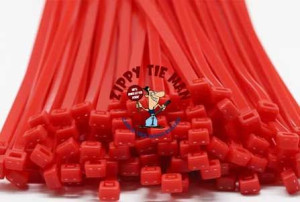
Coloured cable ties are standard nylon cable ties made with a pigment added to the resin, so the finished tie is red, blue, green, yellow, orange, brown, purple, pink or grey instead of natural or black. The pigment changes the appearance. Load rating and locking action come from the size and formulation of the tie, not from its colour.
Our standard coloured nylon range is manufactured from PA66 nylon and specified with a UL94 V-2 flammability rating, the same specification as the rest of our general purpose range. Within that range, a 4.8mm x 200mm red tie carries the same rating as a 4.8mm x 200mm natural one. Ratings vary between manufacturers, so check the specification on any tie you buy rather than assuming colour tells you anything about strength. If you are matching a tie to a bundle weight, our cable tie size and tensile strength chart walks through the widths and ratings.
Colour is an identification layer sitting on top of a fastener you were going to use anyway. That is why it costs so little to adopt: you are not adding hardware, you are adding meaning to the hardware already on the job.
Is there a standard colour code for cable ties?
No. There is no Australian or international standard that assigns a fixed meaning to cable tie colours. What exists instead are strong conventions borrowed from electrical, telecom and process industries, plus site-specific systems written by the business that uses them. A colour code only works if it is documented and applied the same way by everyone.
This is the point competitors skip past. A red tie does not carry legal or regulatory meaning on its own. It carries the meaning your site has written down and trained people on. Two workshops 20 minutes apart can use red for opposite purposes, and both are correct within their own systems.
The conventions below are the ones you will run into most often in Australia. Treat them as a sensible starting point rather than a rulebook.
| Colour | Common Site Use | Important Qualification |
|---|---|---|
| Red | Emergency, fire and danger identification | Site convention, not a cable tie standard |
| Blue | Data and communications runs | Follow your site documented legend |
| Yellow | Caution, gas and chemical lines | Avoid near electrical conductor identification |
| Orange | Temporary works and high visibility | Site convention |
| Purple and Pink | Spare categories, zone or department | Meaning comes entirely from your legend |
| Green and Green/Yellow | Associated with earthing and bonding | Do not repurpose around electrical work |
| Black | Outdoor and solar work | Chosen for UV performance, not identification |
Using coloured cable ties around Australian electrical wiring
A coloured cable tie is a visual marker fitted around a bundle. It is not conductor identification. Conductor identification in Australian installations is governed by AS/NZS 3000, the Wiring Rules, which sets out how conductors must be identified and includes specific requirements, permitted colours and exceptions. A tie colour never satisfies that requirement and never replaces it.
Important:Cable tie colours and conductor colours are two different systems. Cable tie colour meanings are site-specific and voluntary. Conductor identification is governed by the applicable electrical requirements and is work for a licensed electrician. Use ties to help people find the right bundle faster, never to tell them what a conductor is.
That distinction matters more in Australia than most places, because two conductor colour schemes are still in service. Installations wired before the harmonisation around 2000 use different colours to newer work, and the two schemes overlap in ways that can read as the opposite of what someone expects. A tie colour chosen to look intuitive can quietly add a third layer of ambiguity on top of that.
AS/NZS 3000 also carries more nuance than a simple colour chart suggests, including permitted alternatives and exceptions for particular applications. Anyone specifying conductor colours should work from the current standard itself, not from a supplier blog. What we can say usefully is how to keep your tie legend out of the way.
Two rules keep a tie colour system safe around electrical work:
- Do not repurpose green, yellow or green and yellow for general identification. Those colours are associated with protective earthing and bonding under AS/NZS 3000, and conductors with green, yellow or green and yellow insulation must not be used as actives or neutrals in installation wiring. A tie legend that assigns them to data, machine zones or inspection dates creates exactly the ambiguity the standard exists to prevent.
- Do not choose tie colours that mimic conductor colours. If your legend uses the same colours as the conductors in the board, a technician has to work out which system they are reading. Pick colours that read clearly as identification markers instead, such as orange, purple or pink, and put the meaning in your written legend.
If you are unsure how ties sit alongside proper electrical practice, our guide on zip tying electrical wires together covers what is and is not acceptable. For anything involving conductor identification, the answer is a licensed electrician working to the current standard.
Colour coding hydraulic hoses and equipment lines
Hydraulic hoses are one of the strongest uses for coloured cable ties, because the hoses themselves give you almost nothing to go on. Quick couplers look identical, hose covers are black, and the consequences of a wrong connection are immediate. A colour per circuit, fitted at both ends, solves it for a few cents per machine.
Safety boundary:Use cable ties on hydraulic hoses only as identification markers. They must never be used to restrain, clamp, support, bundle under load, or repair a pressurised hose. That work belongs to hose clamps, proper fittings and correctly rated assemblies.
With that boundary set, the method that works on tractors and implements is simple. Assign one colour to each remote pair and fit that colour at the tractor end and the matching implement end. Where pressure and return matter, use two ties on the pressure line and one on the return, or use a lighter and darker shade of the same colour. The operator then matches colour to colour rather than remembering a layout.
Fixed plant works the same way with different categories. Colour by circuit, by function, or by service interval so a fitter can see which hoses fall due together without opening the maintenance file.
A field trick worth copying: back the colour up with a count.
Experienced operators fit one tie on the first pair, two on the second, three on the third. Colour is faster to read, but it fades in sun and disappears at night. Wrap count still works in the dark, through mud, and after two seasons outdoors. You get a system that degrades gracefully instead of failing all at once. It costs nothing, because you are buying coloured cable ties in packs of 100 anyway.
Two more limits to respect:
- Do not cinch the tie down hard on a hose that flexes. A tight nylon tie will work at the cover as the hose moves and abrade it over time. Leave it firm enough to stay in place and no tighter.
- Keep nylon away from hot zones. Near exhausts, engine bays or high temperature lines, use stainless steel ties instead, which handle far higher temperatures than nylon.
If you are working through a hydraulic setup, we also stock hydraulic swivels and hose clamps alongside the tie range.
Where coloured cable ties are used
Coloured cable ties show up anywhere a person has to tell one identical looking thing from another quickly. The industries below account for most of what leaves our Casino warehouse.
Electrical and switchboard work
Grouping runs by function, marking which bundles feed which distribution point, and flagging emergency or fire circuits so nobody isolates the wrong one during a shutdown. Always as a marker alongside proper conductor identification, never instead of it.
Data centres, comms and structured cabling
Separating fibre from copper, patch runs from backbone, and live services from decommissioned ones. Telecommunications already has established fibre identification colour conventions, including TIA-598. Where a tie colour system is used in a comms environment, matching the existing identification scheme rather than inventing a second one reduces confusion.
Agriculture and heavy equipment
Hydraulic remotes, wiring looms on headers and sprayers, irrigation line marking, and fence work. This is the category where the wrap count backup matters most, because the gear lives outside.
Automotive and workshops
Loom identification during a rebuild, marking which harness belongs to which subsystem, and job tracking. Some workshops use a colour per bay or per technician so partly finished jobs do not get mixed up.
Events, signage and hire fleets
Colour per crew, per stage, or per client so cabling and equipment comes back to the right pile at pack down. Hire businesses use a colour per inspection period so anything overdue is obvious on the rack.
Retail, horticulture and general trade
Plant tagging by variety, pallet and batch marking, and securing signage. Colour here is about sorting speed rather than safety.
Are coloured cable ties suitable for outdoor use?
Often not, and colour alone will not tell you. Many standard coloured nylon cable ties are made for indoor or short term identification and may not carry the UV stabilisation used in dedicated outdoor ties. Black ties are commonly formulated with carbon black, which absorbs ultraviolet light and protects the nylon underneath. Check the manufacturer specification rather than assuming.
Unstabilised nylon degrades under prolonged UV exposure. The colour fades, the surface chalks, the material turns brittle, and the tie eventually snaps under a load it used to hold without complaint. Service life varies considerably with formulation, pigment, stabilisers, UV intensity, temperature, mechanical load and how much shade the installation gets, so treat any single figure quoted online with caution and work from the UV rating on the product you are actually buying.
What this means in practice is that colour and outdoor durability are two separate buying decisions. You have four sensible ways to handle both:
- Keep standard coloured ties for indoor, undercover or short exposure work, which covers most switchboard, workshop and comms use anyway.
- Use a tie rated for outdoor exposure as the fastener and a coloured tie purely as a marker beside it. One carries the load, the other carries the meaning, and you replace only the marker.
- Add a wrap count or a written tag so identification survives after the colour fades.
- Use stainless steel ties where exposure is long term and the consequence of failure is serious, such as marine, solar or permanent outdoor plant.
For anything living in permanent sunlight, start with a tie specified for UV exposure. Our black cable ties are UV stabilised as standard, and our article on UV cable ties for outdoor jobs in Australia goes further into service life and material choice.
How to create a colour coding system that survives staff turnover
Most colour coding systems fail for the same reason: the person who invented the system leaves, and nobody else knows what purple meant. A system that lasts is written down, kept short, and visible where the work happens. Six steps get you there.
- List what you actually need to tell apart. Most sites need four or five categories, not twelve. Resist the urge to code everything.
- Assign colours that already carry the right instinct. Red for danger and emergency, blue for data, yellow for caution. Keep green, yellow and green and yellow out of any legend used near electrical work.
- Write a one page legend. Colour, meaning, and one example each. That is the whole document.
- Put the legend where the work is. On the board door, inside the tractor cab, on the workshop wall. A legend in a folder in the office does not get read.
- Buy the whole system from one supplier and one batch where you can. Shades drift between manufacturers, and a dark blue from one brand can read as purple against another brand.
- Review it once a year and when someone new starts. Five minutes at induction saves an hour of tracing later.
Colour tells you what kind of thing a cable or hose is. A written label tells you exactly which one it is. On anything complex, use both. Colour gets a technician to the right bundle in seconds, and the label confirms the specific line before they touch it.
Common mistakes to avoid
- Assuming blue means metal detectable. It does not. Metal detectable ties are a separate product with metal content moulded into the nylon, made for food processing lines. A standard blue nylon tie will not trip a metal detector. If you work in food production, buy the detectable product specifically.
- Treating a tie colour as conductor identification. It is a marker on a bundle, nothing more.
- Repurposing green, yellow or green and yellow in electrical environments, where they are associated with earthing and bonding.
- Choosing standard coloured ties for permanent outdoor installs without checking the UV specification, then blaming tie quality when they fail.
- Running a colour code that lives in one person head. If it is not written down, it is not a system.
- Over-tightening. A tie tensioned until the bundle deforms damages cable insulation and hose covers, and a crushed bundle is a fault waiting to happen.
- Mixing brands mid-project, so the same category ends up in two visibly different shades.
- Coding too many categories. Once you pass six or seven colours, people stop trusting the system and go back to tracing.
The bottom line
- There is no official standard for cable tie colours. Conventions exist, but your documented legend is what makes a system real.
- A coloured cable tie is an identification aid. It never substitutes for electrical conductor identification, which is governed by AS/NZS 3000 and is work for a licensed electrician.
- Keep green, yellow and green and yellow out of any legend used near electrical work.
- On hydraulics, colour each remote pair at both ends and back it up with a wrap count so the system still works once the colour fades. Ties mark hoses, they never restrain them.
- Colour and outdoor durability are separate decisions. Check the UV specification on the product rather than judging by colour.
One thing to do today: write your legend on a single page and stick it where the work happens. Then match the colours to it. You can see the full range ofcolour cable ties in 2.5mm, 4.8mm and larger widths, or call the team on 0400 442 202 for a wholesale quote on a mixed colour order.
Frequently asked questions
Do coloured cable ties have a standard colour code?
No. There is no universal colour code that assigns the same meaning to every cable tie colour. Electrical, telecommunications and industrial sites may each have their own conventions, so document the meaning of each colour and apply the system consistently across your site.
Are coloured cable ties as strong as black ones?
Within a single manufacturer range, yes. Coloured cable ties are moulded from the same nylon as black and natural ties of the same specification, and the pigment does not add strength. Ratings differ between brands, so compare the stated tensile rating rather than the colour.
What do different colour cable ties mean?
There is no fixed meaning. In common practice red marks fire, emergency or do not disconnect circuits, blue marks data and low voltage, green is associated with earthing, and yellow signals caution. Every other colour means whatever your site legend says it means.
Can you use coloured cable ties outside?
For short term work, often yes. For permanent outdoor installations, check the specification first. Many standard coloured ties are made for indoor identification and may lack the UV stabilisation of a dedicated outdoor tie. Colour alone is not proof of UV performance.
What colour cable tie should I use for earth wiring?
Cable ties do not identify earth conductors. Conductor identification is governed by AS/NZS 3000 and is work for a licensed electrician. Keep green, yellow and green and yellow out of your tie legend near electrical work so you never create ambiguity with conductor identification.
Are blue cable ties metal detectable?
No. Standard blue nylon ties contain no metal and will not be picked up by a detector. Metal detectable ties are a separate product built for food processing, with metal content moulded into the nylon. Colour alone is never proof of detectability.
What size cable tie is best for marking hydraulic hoses?
A 4.8mm width in 200mm or 300mm length suits most hydraulic hose diameters and stays visible from a distance. Use 2.5mm on small lines and wiring looms. Fit the tie firmly but not tight, so it does not abrade the hose cover as it flexes.
How many colours should a colour coding system use?
Four to six works best. Fewer than four and you are not gaining much over no system at all. More than seven and people stop trusting the legend and go back to tracing lines by hand. Keep categories broad and the legend short.
Sources and standards referenced
- Standards Australia and Standards New Zealand. AS/NZS 3000:2018, Electrical installations (the Australian/New Zealand Wiring Rules). Clause 3.8 covers conductor identification, colour identification and exceptions. Work from the current standard itself for any conductor identification question.
- International Electrotechnical Commission. IEC 60445:2021, Basic and safety principles for man-machine interface, marking and identification. Identification of equipment terminals, conductor terminations and conductors.
- TIA-598, Optical Fibre Cable Colour Coding. The colour convention used to identify fibres and cable units in telecommunications.
- UL 94, Standard for Safety of Flammability of Plastic Materials for Parts in Devices and Appliances. Flammability classifications are assigned to a tested material and product configuration, not to a colour or to a product category.
- Zippy Tie Man product specifications for the PA66 nylon range, including the UL94 V-2 classification stated for our standard nylon ties.
Last reviewed: September 2026. Next review: September 2028 (evergreen, low volatility). Review earlier if AS/NZS 3000 is amended.