







What Are Cable Ties? Cable Ties vs Zip Ties Explained (2026)
Walk into any hardware store in Australia and you will see the same product on two different shelf tickets. One says cable ties. The other says zip ties. Same bag, same nylon strap, often the same manufacturer.
That naming split confuses more buyers than almost anything else in cable management. It leads people to assume one is the stronger, more professional option and the other is the cheap version. It is not that simple, and this guide sorts it out. Below you will find what a cable tie actually is, how the locking head works, what the strap is made from, and how to choose one that holds instead of snapping halfway through a job.
What is a cable tie?

A cable tie is a self-locking fastener made of a toothed strap and a small head containing a ratchet. The strap threads through the head, tightens in one direction only, and holds a bundle securely. Cable ties are also sold as zip ties and tie wraps, which are the same product under different names.
In this guide:
- What Are Cable Ties?
- Are Cable Ties and Zip Ties the Same Thing?
- How a Cable Tie Actually Works
- What Cable Ties Are Made Of
- What Cable Ties Are Used For
- Cable Ties Compared to Other Fasteners
- How to Use a Cable Tie Properly
- What Cable Ties Should Never Be Used For
- FAQ
- Our Final Verdict
What Are Cable Ties?
A cable tie is a one-piece fastener used to bundle, secure, and organise cables, wires, hoses, and other objects. It has a flexible strap with teeth along one face and a moulded head at one end. Threading the strap through the head creates an adjustable loop that tightens but will not loosen on its own.
The design has barely changed since it was patented. What has changed is the range: ties now run from roughly 100mm long for a handful of data cables up to 600mm and beyond for industrial conduit bundles.
Strength scales with width and material rather than length. A 2.5mm nylon tie and a 12.7mm nylon tie behave very differently under load, which is why width matters more than most first-time buyers expect. Our cable tie size chart sets out the full length and width run with tensile ratings.
Are Cable Ties and Zip Ties the Same Thing?
Yes. Cable tie, zip tie, and tie wrap all describe the same fastener. The difference is regional and industry habit, not construction, material, or strength rating. Manufacturers publish identical specifications under all three names, so a 200mm x 4.8mm zip tie and a 200mm x 4.8mm cable tie are the same item.
Which word people reach for tends to follow where they are and what they do for a living.
| Term | Where It Is Common | Typical Context |
|---|---|---|
| Cable tie | Australia, UK, New Zealand, and much of Asia | Trade, electrical, and industrial specifications |
| Zip tie | United States and casual use worldwide | DIY, home, IT, and general conversation |
| Tie wrap | Legacy trade and manufacturing usage | Older technical documentation |
| Ty-Rap | Original brand name | Trademarked product line, now sometimes used loosely |
In Australia, tradespeople and suppliers mostly say cable ties, while zip ties turns up more in household and online searches. Both terms will get you the same product from any Australian supplier.
Where the Two Names Came From
The fastener was invented in 1958 by Maurus C. Logan, an engineer at the American electrical manufacturer Thomas and Betts, who had watched aircraft wiring being tied by hand with waxed braided cord at a Boeing facility. His product was trademarked as the Ty-Rap.
Cable tie stuck as the technical description because the original job was tying cable looms. Zip tie came later as everyday shorthand, borrowed from the zipping sound the strap makes as it pulls through the head.
Zippy Tie Man Expert Tip: If you are writing a specification, quoting a job, or ordering for a trade account, use cable tie plus the length, width, and material. Supplier catalogues and datasheets are indexed on that wording, so it removes any ambiguity about what you are actually asking for.
The "Cable Ties Are Stronger Than Zip Ties" Myth
Several buying guides claim cable ties are the heavy duty option and zip ties are the light duty one. That distinction does not exist in any manufacturing standard.
Strength comes from three things: strap width, wall thickness, and material. A tie labelled zip tie can easily outperform one labelled cable tie if it is wider or made from stainless steel. Judge a tie by its stated tensile rating and material specification, never by which of the two names the packaging uses.
How a Cable Tie Actually Works
A cable tie works through a one-way ratchet. Teeth on the strap engage a small hinged pawl inside the head. The pawl lets the teeth pass in the tightening direction and blocks them in the other, which is why a standard tie can be pulled tighter at any time but cannot be backed off.
The parts worth knowing:
- Tail. The tapered end you feed through the head first.
- Strap. The flexible toothed body that forms the loop.
- Teeth. The moulded ridges the locking pawl grips.
- Head. The moulded housing that contains the locking mechanism.
- Pawl. The internal tooth that engages the strap and stops it reversing.
Releasable ties change one thing in that sequence. A lever or tab on the head lifts the pawl clear of the teeth, so the loop opens without cutting. Everything else works the same way. Our releasable cable ties suit installs that get adjusted or added to repeatedly.
What Cable Ties Are Made Of
Most cable ties are moulded from nylon 6/6, a polyamide chosen for its balance of flexibility, strength, and chemical resistance. Specialist versions use stainless steel, UV-stabilised nylon, heat-stabilised grades, or metal-detectable compounds for food and pharmaceutical sites.
Nylon 6/6. The default for general electrical, automotive, and household work. Flexible, affordable, and available across the widest size range. Untreated nylon degrades under prolonged sunlight, so it belongs indoors or under cover.
UV-stabilised nylon. Standard nylon with additives, usually carbon black, that slow sunlight-driven breakdown. This is the right choice for solar, garden, rooftop, and exterior work. The detail on how to verify a genuine UV rating is covered in our guide to UV cable ties for outdoor jobs.
Stainless steel. Uses a ball-lock head rather than a plastic pawl, and handles heat, corrosion, and chemicals that would destroy nylon. Grade 304 covers general industrial work and grade 316 is the marine standard. Browse our stainless steel cable ties for exhaust, marine, and high-heat jobs.
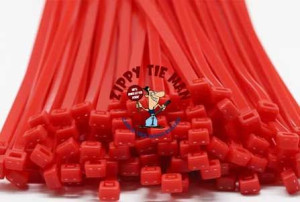
Coloured nylon. Same material as standard nylon, pigmented for identification. Coloured cable ties are widely used to code circuits, zones, or phases so technicians can trace a bundle without reading a label.
Buying Rule: Black is not automatically UV rated. Carbon black is the common UV additive, but a black tie without a stated UV specification may simply be pigmented. Check the specification, not the colour.
What Cable Ties Are Used For
Cable ties are used anywhere something needs bundling, routing, or holding in position quickly and without tools. Cable management remains the primary use, but the fastener has spread well beyond electrical work.
- Electrical. Bundling and dressing wiring in switchboards, enclosures, and conduit runs. Whether ties are appropriate for a specific wiring job is covered in our guide on zip tying electrical wires together.
- Automotive. Securing looms and hoses against engine bay vibration, with heat-rated or stainless options near exhausts.
- Marine. Grade 316 stainless for salt air, where nylon and lesser grades corrode or perish.
- Solar and rooftop. UV-stabilised black nylon for cabling under permanent sun exposure.
- Construction and scaffolding. Heavy duty ties for temporary bundling of conduit, hose, and site services.
- Agriculture and horticulture. Long UV ties for trellising, fencing, and irrigation lines.
- Data centres and networking. Narrow 2.5mm to 3.6mm ties that bundle without compressing cable cores.
- Food and pharmaceutical. Metal-detectable ties so any fragment is caught by inline detection.
Cable Ties Compared to Other Fasteners
Choosing between a cable tie and another fastener usually comes down to one question: does the bundle need to be opened again?
| Fastener | Reusable | Typical Strength | Best For |
|---|---|---|---|
| Standard nylon cable tie | No, cut to remove | Light to heavy, depending on width | Permanent bundling and cable routing |
| Releasable cable tie | Yes | Slightly below an equivalent standard tie | Installations that change or grow |
| Hook and loop strap | Yes, many times | Low | Data cables and frequent access |
| Stainless steel cable tie | No, cut to remove | Very high | Heat, corrosion, marine, and industrial applications |
| Hose clamp | Yes, adjustable | High, in compression | Sealing a hose to a fitting |
A hook and loop strap is gentler on delicate cable and better for anything you open weekly. A cable tie is faster, cheaper per unit, and holds far more load. A hose clamp does a different job entirely: it seals rather than bundles.
How to Use a Cable Tie Properly
- Group the bundle first. Arrange the cables the way they should sit before you tighten anything. A tie cannot fix a messy bundle.
- Thread the tail through the head. Form a loop slightly larger than the bundle.
- Pull to firm, not to maximum. The bundle should be held without the strap biting into insulation.
- Space multiple ties evenly. Roughly every 150mm to 300mm along a run keeps the bundle straight.
- Trim flush. Cut the tail level with the head. Side cutters leave a sharp stub that catches hands and clothing, so use a flush cutter or a tensioning tool.
- Check under load. Move the bundle and confirm nothing slips.
For volume work, a tensioning tool sets consistent tension and cuts flush in one action, which is quicker and safer than hand-tightening hundreds of ties. Our range of cable tie guns and crimping tools covers nylon and stainless tools. For a fixed anchor point without a separate mount and screw, push mount ties combine the tie and base in one piece.
What Cable Ties Should Never Be Used For
Cable ties are bundling devices, not rated lifting or load-bearing hardware. A few limits are worth stating plainly.
- Never use a cable tie as the sole support for a load overhead, or for anything where failure could injure someone.
- Never use them for rigging, towing, or any lifting application.
- Do not rely on standard nylon in permanent outdoor positions, or near heat sources. Temperature limits are set out in our cable tie temperature rating guide.
- Avoid over-tightening on data, fibre, or thin-insulation cable, since compression can affect performance.
- Do not fit them tightly around anything living or growing, including plants and animals.
The Bottom Line
- Cable ties and zip ties are the same fastener. The name reflects region and industry, not specification.
- The locking head uses a one-way ratchet, which is why a standard tie tightens but never loosens.
- Nylon 6/6 covers most indoor work; UV-stabilised nylon and stainless steel handle outdoor, marine, and high-heat conditions.
- Width and material determine strength, not the word on the packet.
- Cable ties bundle and organise. They are not rated lifting or structural hardware.
Before your next order, check the width and material against the job rather than reaching for whatever pack is nearest. Browse the full range of cable ties or contact our team for a bulk or trade quote.
FAQ
Are zip ties and cable ties the same thing?
Yes. They are the same fastener under different names. Cable tie is standard in Australia and the UK, zip tie is more common in the United States and in casual use. Specifications, materials, and sizing conventions are identical.
What are cable ties made from?
Most are moulded from nylon 6/6. Specialist versions use UV-stabilised nylon for outdoor exposure, stainless steel in grades 304 and 316 for heat and corrosion, and metal-detectable compounds for food processing environments.
Who invented cable ties?
Maurus C. Logan, an engineer at Thomas and Betts, developed the cable tie after seeing aircraft wiring tied by hand at a Boeing facility. It was patented in 1958 under the brand name Ty-Rap.
How much weight can a cable tie hold?
It depends on width and material. Narrow 2.5mm nylon ties hold only a few kilograms, while wide heavy duty and stainless ties hold well over 100kg. Always allow a safety margin above the actual load.
Can cable ties be reused?
Standard ties cannot. The locking pawl is designed to be cut off, not reopened. Releasable ties have a tab that lifts the pawl, so they can be opened and refitted without cutting.
Why do black cable ties get used outdoors?
Carbon black is a common UV-stabilising additive, so many outdoor-rated ties are black. Colour alone is not proof of a UV rating, so check that the specification states UV stabilisation.
Do cable ties expire or go brittle?
Nylon absorbs moisture and degrades under sustained UV exposure, so ties stored in sunlight or fitted outdoors without UV stabilisation will stiffen and crack over time. Store stock in a cool, dry, dark place.
Our Final Verdict
The naming question has a simple answer: a cable tie and a zip tie are the same thing, and any guide claiming one is inherently stronger is confusing vocabulary with specification. What genuinely changes performance is the width, the wall thickness, and the material, which is where your attention should go before you buy.
Match the material to the environment first, then size the width to the load with room to spare, then pick the length. Get that order right and the tie will outlast the job it was fitted for.